
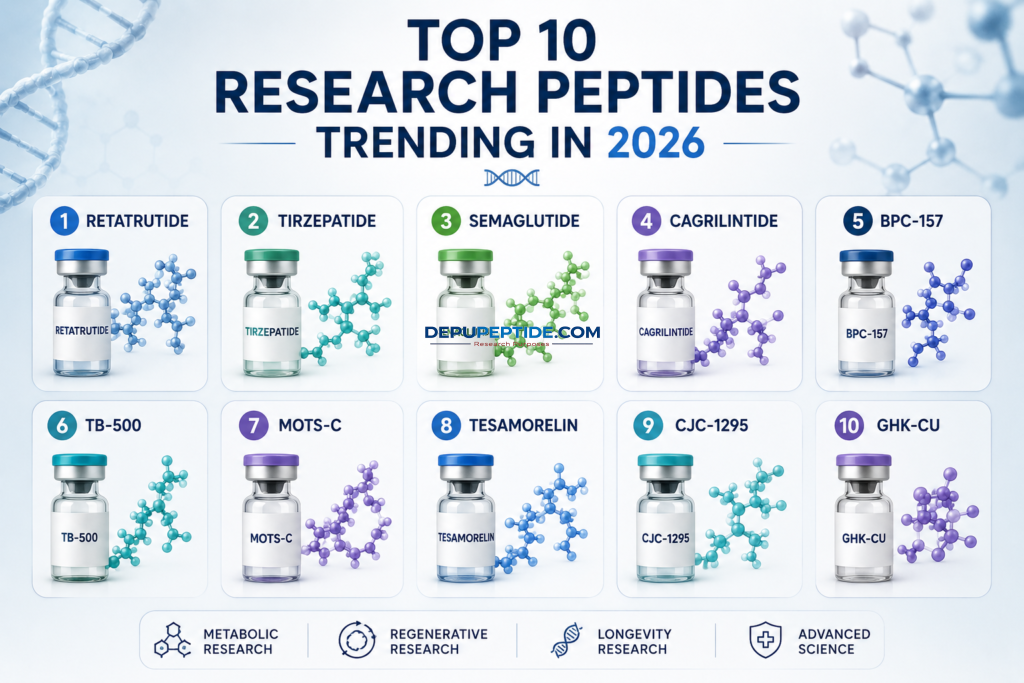
Top 10 Research Peptides Trending in 2026
The Most Popular Research Peptides in 2026
The field of peptide research continues to evolve rapidly, with scientists and biotechnology organizations exploring innovative compounds that target a wide range of biological pathways. In 2026, several peptides have emerged as leading subjects of scientific investigation due to their unique receptor activity, advanced molecular design, and growing importance in research applications.
From next-generation GLP-1 receptor agonists to regenerative and longevity-focused compounds, peptide science is expanding into new areas of discovery. Researchers worldwide are increasingly focusing on peptides that offer novel mechanisms of action and the potential to deepen our understanding of metabolic regulation, cellular function, and biological signaling.
In this guide, we explore the top 10 research peptides trending in 2026 and why they continue to attract attention within the scientific community.
1. Retatrutide
Retatrutide has become one of the most discussed peptides in modern research. As a triple receptor agonist, it simultaneously targets:
- GLP-1 receptors
- GIP receptors
- Glucagon receptors
This unique mechanism has positioned Retatrutide as one of the most advanced metabolic peptides currently under investigation. Researchers continue to explore its complex receptor interactions and potential applications within metabolic studies.
Why It’s Trending
- Triple receptor activity
- Next-generation peptide design
- Significant scientific interest
- Rapidly growing research volume
2. Tirzepatide
Tirzepatide remains one of the most recognized peptides in the scientific community. Its dual agonist activity targeting both GLP-1 and GIP receptors has made it a cornerstone of metabolic research.
Researchers continue to study its receptor interactions and biological signaling pathways, making it one of the most frequently referenced peptides in scientific literature.
Why It’s Trending
- Dual receptor agonist
- Strong research demand
- Extensive scientific investigations
- High global interest
3. Semaglutide
Semaglutide continues to maintain a prominent position in peptide research. As a GLP-1 receptor agonist, it has been widely studied for its role in metabolic signaling pathways.
Its established research history and ongoing scientific interest make it one of the most searched peptide compounds worldwide.
Why It’s Trending
- Well-established research peptide
- Significant scientific publications
- Ongoing global interest
- Important metabolic research applications
4. Cagrilintide
Cagrilintide has attracted growing attention due to its unique amylin receptor activity. Researchers are exploring its potential role within advanced metabolic studies and peptide combinations.
Its increasing popularity has made it one of the fastest-growing names in peptide research.
Why It’s Trending
- Innovative mechanism of action
- Growing scientific focus
- Often studied alongside GLP-1 peptides
- Rising industry attention
5. BPC-157
BPC-157 remains one of the most popular peptides among researchers investigating cellular recovery and biological repair mechanisms.
Its long-standing presence within peptide research has helped maintain its popularity despite the emergence of newer compounds.
Why It’s Trending
- Consistent research interest
- Widely recognized peptide
- Extensive scientific discussions
- Strong community awareness
6. TB-500
TB-500 continues to generate interest due to its connection with cellular movement and regenerative research pathways.
Researchers frequently include TB-500 in studies involving biological repair mechanisms and tissue-related investigations.
Why It’s Trending
- Regenerative research focus
- Established scientific interest
- Frequently studied alongside BPC-157
- Continued popularity in research circles
7. MOTS-c
MOTS-c has become increasingly important in mitochondrial research and cellular energy studies.
As interest in longevity science grows, researchers are paying closer attention to peptides involved in cellular metabolism and energy regulation.
Why It’s Trending
- Longevity research applications
- Mitochondrial function studies
- Expanding scientific investigations
- Emerging peptide category
8. Tesamorelin
Tesamorelin remains a significant peptide in growth hormone-related research.
Scientists continue exploring its biological effects and receptor activity, helping maintain its relevance within peptide science.
Why It’s Trending
- Growth hormone research
- Well-established peptide profile
- Ongoing scientific investigations
- Consistent demand
9. CJC-1295
CJC-1295 remains one of the most widely recognized growth hormone-releasing peptides.
Researchers continue studying its long-acting properties and receptor interactions, contributing to its enduring popularity.
Why It’s Trending
- Long-standing research peptide
- Growth hormone pathway studies
- Strong scientific recognition
- Frequently referenced in research literature
10. GHK-Cu
GHK-Cu continues to attract significant attention in peptide and cosmetic research sectors.
Its unique copper-binding structure has generated scientific interest in studies involving cellular function and biological processes.
Why It’s Trending
- Growing cosmetic research market
- Widely recognized peptide
- Expanding scientific interest
- Strong industry demand
Why Peptide Research Is Growing in 2026
Several factors are contributing to the rapid expansion of peptide research worldwide.
Advances in Biotechnology
Improved manufacturing methods and analytical technologies have increased access to high-quality peptides for scientific studies.
Growing Scientific Interest
Researchers continue discovering new peptide pathways and receptor targets that may unlock valuable biological insights.
Innovation in Multi-Receptor Peptides
Compounds such as Tirzepatide and Retatrutide demonstrate how peptide engineering is evolving toward more advanced receptor-targeting strategies.
Expansion of Longevity Research
Interest in healthy aging, mitochondrial function, and cellular biology has driven increased attention toward peptides like MOTS-c and GHK-Cu.
The Future of Research Peptides
The peptide industry is expected to continue growing as scientists explore increasingly sophisticated compounds capable of targeting multiple biological pathways simultaneously.
Future trends may include:
- Advanced receptor agonists
- Multi-functional peptide designs
- Longevity-focused compounds
- Enhanced metabolic peptides
- Precision-targeted biological therapies
As peptide science advances, researchers can expect continued innovation and expanding opportunities for discovery.
Conclusion
The top research peptides trending in 2026 highlight the growing importance of peptide science across biotechnology, metabolic research, regenerative studies, and longevity investigations.
Retatrutide, Tirzepatide, Semaglutide, Cagrilintide, BPC-157, TB-500, MOTS-c, Tesamorelin, CJC-1295, and GHK-Cu are among the most discussed compounds currently shaping the future of peptide research. As scientific understanding continues to expand, these peptides are likely to remain at the forefront of innovation and discovery.